
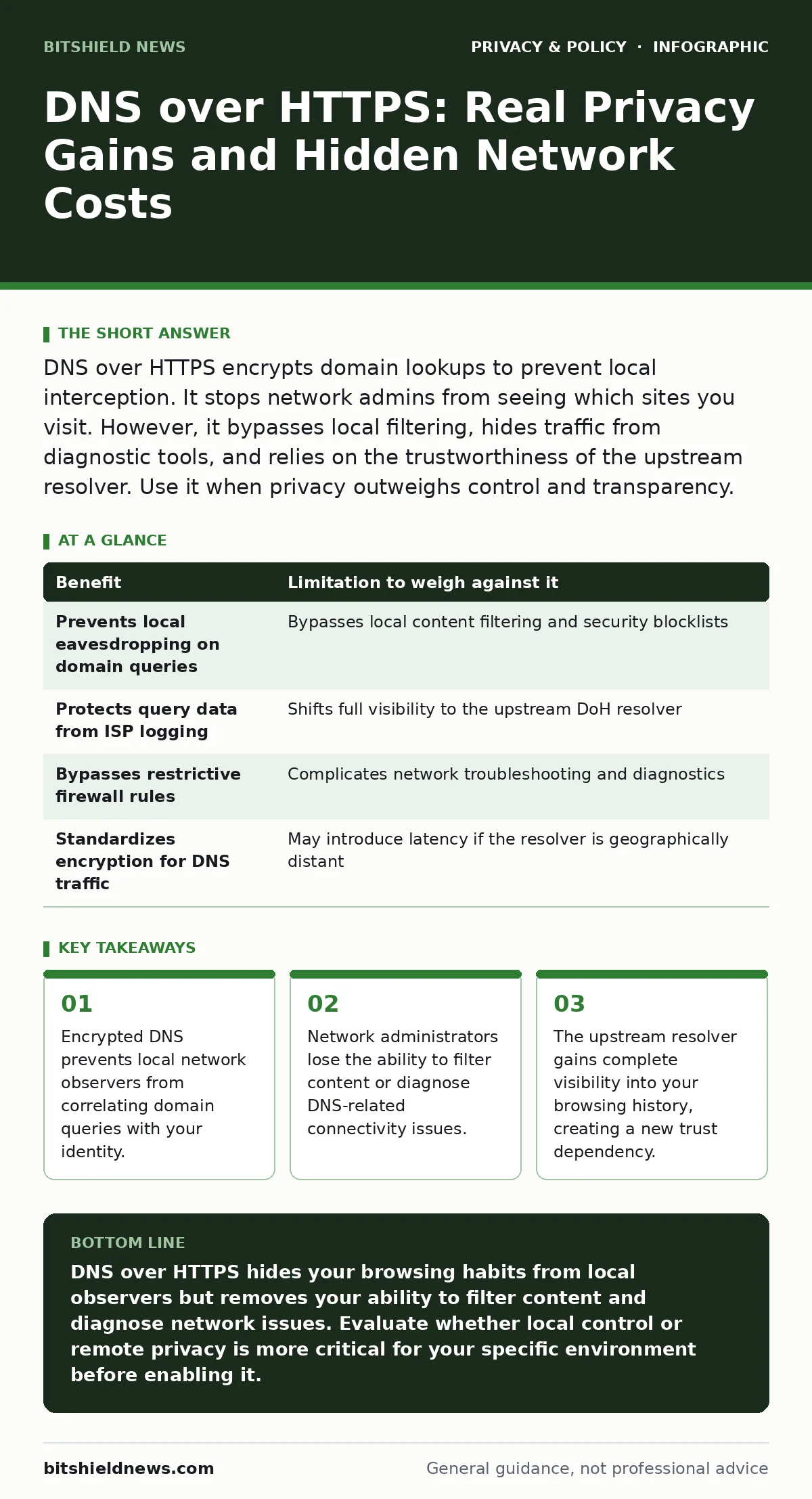
DNS over HTTPS encrypts domain lookups to prevent local interception. It stops network admins from seeing which sites you visit. However, it bypasses local filtering, hides traffic from diagnostic tools, and relies on the trustworthiness of the upstream resolver. Use it when privacy outweighs control and transparency.
The Mechanics of Encrypted Resolution
Domain Name System (DNS) translates human-readable website names into numerical IP addresses. Traditionally, these queries travel in plain text. Anyone with access to the network cable, Wi-Fi signal, or router logs can see every domain you request. DNS over HTTPS (DoH) wraps these queries in standard HTTPS encryption. This makes the traffic indistinguishable from regular web browsing.
The protocol uses port 443, the same port used for secure web traffic. This design choice allows DoH to bypass firewalls that block standard DNS ports. It also prevents deep packet inspection tools from reading the query payload. You are essentially asking a remote server for an address inside a sealed envelope.
The Privacy Shield Against Local Observation
The primary benefit of DoH is local privacy. On public Wi-Fi networks, coffee shops, or corporate offices, local observers can map your activity by watching DNS traffic. DoH renders this invisible. The network administrator sees that you are talking to a DNS provider, but they cannot see which specific domains you are resolving.
This protection extends to Internet Service Providers (ISPs) that might otherwise log and sell browsing metadata. By routing queries through an external DoH resolver, you break the link between your local IP address and your query history at the network level. The ISP sees encrypted traffic to a known DNS endpoint, not a list of visited sites.
This mechanism is particularly effective against passive surveillance. It does not hide your activity from the destination website or the DoH provider itself. It only removes the ability for intermediate network nodes to build a profile of your interests based on domain lookups.
The Loss of Local Control and Filtering
Every security measure carries a trade-off. The most significant cost of DoH is the loss of local network control. Corporate networks and home routers often use DNS filtering to block malicious domains, adult content, or distracting sites. DoH bypasses these local filters entirely.
When a device uses DoH, it ignores the local DNS server configured by the network administrator. It contacts an external resolver directly. This means parental controls, workplace productivity filters, and security blocklists hosted on your local network become ineffective for that device. The traffic exits the network before local policies can inspect it.
This bypass is not a bug; it is a feature of the encryption. The resolver you choose determines what gets blocked. If that resolver has a weaker blocklist than your local network, your protection decreases. You are trading local enforcement for the policy of a remote entity.
Diagnostic Blind Spots
Network troubleshooting relies heavily on visibility. When a website fails to load, administrators check DNS resolution first. Standard DNS allows tools to trace the path of the query and identify where it fails. DoH obscures this path.
Because the queries are encrypted and routed over HTTPS, standard network diagnostic tools cannot read them. You cannot use simple packet captures to see if a domain resolves correctly. You must rely on the application layer or specific DoH-aware tools. This adds complexity to routine IT support tasks.
If a DoH resolver is down or misconfigured, the user experiences a total loss of connectivity for domains not cached locally. There is no fallback to the local DNS server unless the application is explicitly coded to failover. This single point of failure can disrupt operations during outages.
Balancing Benefits and Limitations
The decision to use DoH requires weighing privacy against control. Below is a comparison of the primary advantages and the corresponding costs you must accept.
| Benefit | Limitation to weigh against it |
|---|---|
| Prevents local eavesdropping on domain queries | Bypasses local content filtering and security blocklists |
| Protects query data from ISP logging | Shifts full visibility to the upstream DoH resolver |
| Bypasses restrictive firewall rules | Complicates network troubleshooting and diagnostics |
| Standardizes encryption for DNS traffic | May introduce latency if the resolver is geographically distant |
See also: Smart home privacy risks prevention checklist for your network · Citrix NetScaler Mistakes That Leave Your Network Open
When It Is Worth It
You should use DNS over HTTPS when you are on untrusted networks. Public Wi-Fi, hotel networks, and shared office spaces are prime environments for passive monitoring. In these cases, the risk of local interception outweighs the loss of local filtering.
It is also worth it for individuals who prioritize privacy over parental controls or workplace monitoring. If you do not rely on local DNS filtering for safety, DoH provides a strong layer of obscurity against network-level profiling. It complements other privacy tools like tracker blockers and ad blockers by hiding the initial request that often triggers tracking scripts.
For organizations, it may be worth it for mobile devices that frequently roam between networks. Ensuring consistent privacy policies for employees on the go can be achieved through DoH, provided the organization mandates a trusted resolver.
When It Is Not
Do not use DNS over HTTPS on networks that rely on DNS for security enforcement. If your home router blocks malware domains or your workplace filters inappropriate content, DoH will disable these protections. The convenience of privacy comes at the cost of safety in these contexts.
It is also not worth it if you lack the technical expertise to configure it correctly. Misconfigured DoH can lead to resolution failures or reliance on default, potentially less private resolvers. For users who depend on local network diagnostics, the added complexity of encrypted DNS may hinder their ability to maintain network health.
In environments where app permission management is critical, forcing DoH can conflict with system-level restrictions. Some operating systems allow apps to bypass DoH, creating inconsistent privacy postures. If you cannot enforce DoH system-wide, the partial protection may give a false sense of security.
Key takeaways
- Encrypted DNS prevents local network observers from correlating domain queries with your identity.
- Network administrators lose the ability to filter content or diagnose DNS-related connectivity issues.
- The upstream resolver gains complete visibility into your browsing history, creating a new trust dependency.
DNS over HTTPS hides your browsing habits from local observers but removes your ability to filter content and diagnose network issues. Evaluate whether local control or remote privacy is more critical for your specific environment before enabling it.
Frequently asked questions
Does DNS over HTTPS hide my IP address?
No, it only encrypts the domain name queries. Your IP address remains visible to the websites you visit and the DoH resolver you use.
Can my employer still see what I browse with DoH?
They cannot see the domains via DNS logs, but they can still monitor unencrypted HTTP traffic or use other methods to inspect web content.
Is DNS over HTTPS faster than standard DNS?
It can be slower due to the overhead of HTTPS encryption and the distance to the resolver, though modern implementations often mitigate this latency.
Does DoH protect against all forms of online tracking?
No, it only protects the initial DNS lookup. It does not prevent tracking via cookies, **email tracking pixels**, or **file metadata** embedded in downloaded content.
How this guide was produced: written by the BitShield News editorial team with AI assistance, checked against the public references listed below, and reviewed when the facts change. See our editorial policy or report an error.