Key points
- Meta deployed a 1,300-line orchestrator to route tasks to 14 specialized AI agents.
- Single agents failed with 10-20% success without manual prompt engineering per task.
- Multi-agent systems showed 65.3% accuracy versus 16.6% for single agents in research.
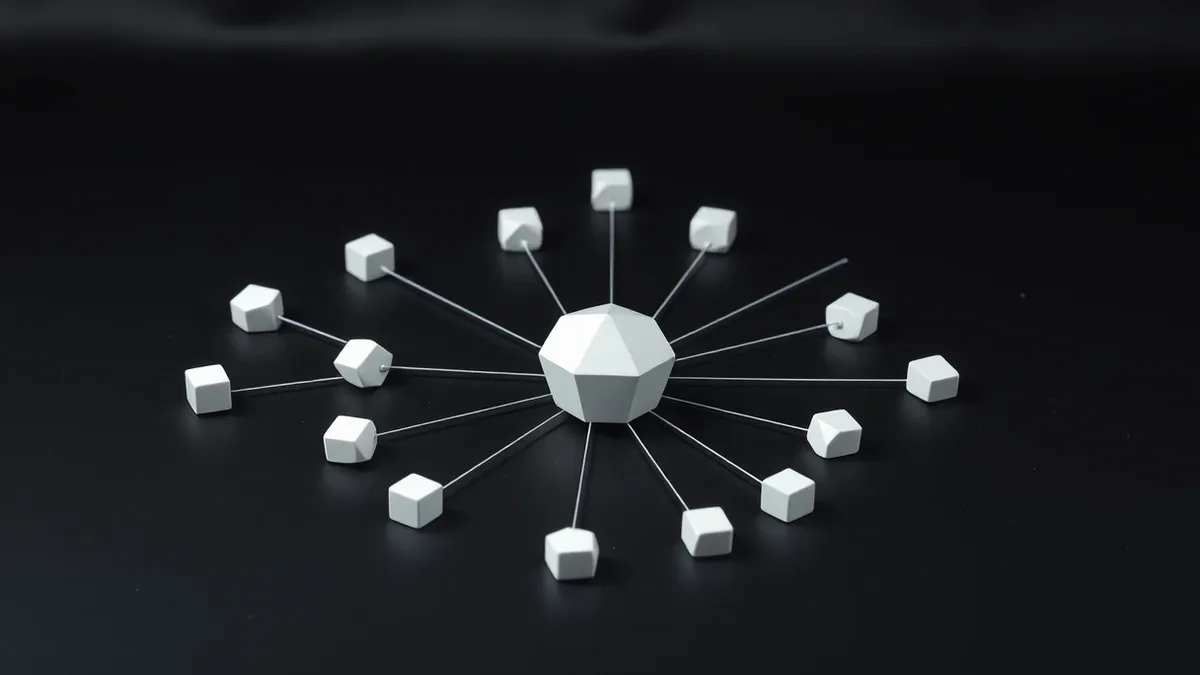
Meta engineers have restructured their data pipeline automation by replacing a single omniscient AI agent with a network of 14 specialized agents. This architectural shift, detailed in research published by Engineering at Meta, addresses the hallucination and context interference that plagued their initial single-agent approach. The new system uses a thin orchestrator to route work, ensuring that domain-specific reasoning remains isolated within individual specialist agents.
By the numbers
- 1,300 lines of code comprise the central orchestrator that performs zero domain work.
- 14 specialized AI agents handle distinct tasks like schema management and code generation.
- 65.3% accuracy achieved by multi-agent systems in Windreich Department preprint research.
What the figures mean
The data indicates that consolidating all knowledge into one agent degrades performance as context thresholds are exceeded. According to the source material, the single agent cross-contaminated concepts, such as applying field naming conventions from one subsystem to another. A preprint from the Windreich Department of Artificial Intelligence and Human Health at Mount Sinai supports this finding, noting that isolated tasks prevent context interference. Meta’s initial single-agent approach required extensive manual prompt engineering to achieve 70-80% success; without it, success rates dropped to 10-20%.
This architectural change aligns with broader industry challenges regarding AI agent efficiency. As BitShield News reported on 2026-10-12, connectivity constraints and latency spikes are primary bottlenecks for enterprise AI deployment. By reducing the cognitive load on the central router and isolating domain logic, Meta aims to improve both accuracy and token efficiency. The thin orchestrator pattern ensures that the central component only handles sequencing and reliability checks, leaving complex reasoning to specialists.
What should you do?
Organizations evaluating AI agents for complex workflows should assess whether a single model is overwhelmed by context. Teams usually benefit from separating routing logic from domain-specific execution. Check whether your current agents are mixing unrelated data sources or configuration rules. Verify that reliability checks are deterministic and separate from the reasoning process. Ensure that each specialist agent has isolated context to prevent cross-contamination of concepts.
Operational impact
When adopting multi-agent architectures, operations teams must define clear boundaries between routing and execution. Suppliers providing AI automation tools should clarify how context is managed across agents. Internal stakeholders need to understand that isolation improves accuracy but requires more complex orchestration logic. Security teams should verify that the orchestrator does not expose sensitive domain data to unauthorized agents. Change management processes must account for the increased number of components requiring monitoring and updates.
What to do and how to stay safe
- Audit existing AI agents for signs of context interference or cross-contamination of unrelated data.
- Implement deterministic reliability checks that operate independently of domain-specific reasoning tasks.
- Isolate specialized tasks into separate agents to prevent knowledge degradation from excessive context.
- Monitor token usage and accuracy rates to evaluate the efficiency of multi-agent versus single-agent setups.
Step-by-step guide: Shadow AI Explained: 8 Questions Answered for Secure Operations
General security guidance from the BitShield News newsroom. It is not confirmed advice from the organisations named in this story.